
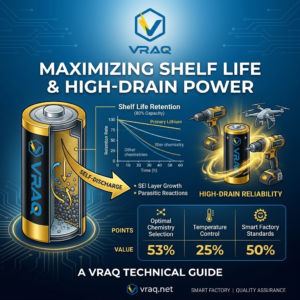
In highdrain applications—ranging from medical devices and professional audio gear to smart home security systems and industrial tools—battery reliability is nonnegotiable. A power source that drains passively on the shelf or drops voltage unexpectedly during peak operating loads can compromise device functionality and brand trust.
Understanding the balance between shelf life and selfdischarge rates is critical for product designers, engineers, and procurement managers when selecting cell chemistries for highdrain hardware.
1. Defining the Core Metrics
To optimize power delivery, it helps to separate storage longevity from operational discharge.
- Shelf Life: The duration a battery can remain in storage under specified conditions while retaining a predefined percentage of its original rated capacity (typically 80%).
- Self-Discharge Rate: The internal chemical reaction that gradually reduces a cell’s stored charge over time, even when completely disconnected from an external circuit.
- HighDrain vs. LowDrain Profiles: Highdrain applications demand rapid current draw (C-rate > 1C) over short periods, making low internal resistance (IR) crucial. Lowdrain devices (e.g., standard wall clocks) consume microamps steadily over years.
2. Chemical Mechanisms Behind Self-Discharge
Self-discharge is primarily driven by unwanted thermodynamic and parasitic reactions occurring at the electrodeelectrolyte interface:
- Electrolyte Degradation: Parasitic side reactions continuously consume active ions and electrolyte components.
- SEI Layer Evolution: In lithiumbased chemistries, the Solid Electrolyte Interphase (SEI) layer grows over time, increasing internal resistance (IR) and trapping active lithium.
- Impurities & Micro-Shorts: Trace metallic contaminants introduced during lowgrade manufacturing accelerate internal leakage currents.
3. Comparing Chemistries for HighDrain Storage & Performance
Battery Chemistry – Typical Monthly Self Discharge (20°c) – Average Shelf Life – High Drain Suitability – Primary Industrial/OEM Applications
- Lithium Iron Phosphate (LiFePO4) – 1,5% to 3% – 7 to 10 Years – Excellent – Energy storage systems, EVs, Heavy Equipment
- Primary Lithium (Li-Fes2 / Li-MnO2) – < 0,5% – 10 to 15+ Years – Excellent – Emergency medical gear, military, remote sensors
- Standard Alkaline (Zn/MnO2) – 0,2% to 0,3% – 5 to 10 Years Moderate to poor – Low-to-mid drain electronics, consumer handhelds
- Nickel-Metal Hydride (NI-MH Standards) – 15% to 30% – 1 to 2 Years – Good High-cycle consumer devices
- Low Self-Discharge NI-MH (LSD) – 1% to 2% – 3 to 5 Years Good Flash units, motorized tools, backup units
4. Key Factors Accelerating Capacity Loss
Ambient Storage Temperature
Chemical reaction rates scale with temperature according to the Arrhenius equation. As a general rule of thumb, every 10°C (18°F) increase above room temperature doubles the rate of selfdischarge and grid corrosion.
Storage State of Charge (SoC)
For secondary lithium systems, storing cells at 100% SoC combined with high temperatures accelerates structural degradation of the cathode and thickens the SEI layer. Storing at 40% – 60% SoC balances structural stability and selfdischarge protection.
5. Engineering Strategies for HighDrain Reliability
When designing products or specifying OEM cells for highdrain hardware:
- Specify Strict Purity Standards: Ensure your OEM partner utilizes highgrade separator materials and automated cleanroom assembly to minimize internal microshorts.
- Implement Intelligent BMS Sleep Modes: Ensure your electronic control unit (ECU) or Battery Management System (BMS) features submicroamp standby currents to prevent external parasitic drain.
- Optimize Thermal Management: Design battery enclosures to dissipate heat efficiently during operation and store units in climatecontrolled environments.
Summary
Selecting the correct battery chemistry for highdrain applications requires balancing peak discharge capability with longterm storage stability. Primary Lithium and lowselfdischarge rechargeable chemistries offer the optimal baseline for devices requiring immediate high power after prolonged storage periods.